Archive for the 'the larger world' Category

That $20 Billion BP deal

Various Republicans have characterized the recently announced 20 billion dollar deal between the government and BP as a “shakedown” for a slush fund, one that Obama doesn’t have constitutional authority to set up. From what I’ve read, it strikes me as a pretty straightforward deal, not wildly different than the way I used an escrow company as an independent party when selling testing.com. Or that unpleasant incident with my neighbor’s grill a few years back…

Me: You careless oaf! You burned up my lawn!

Him: I admit it. I take full responsibility. Sorry.

Me: You’re going to pay for this damage, you know. All of it.

Him: I will do that.

Me: I bet that big old maple that overhangs the house is going to have to come out. That’s going to cost you a bundle.

Him: Oh now, it doesn’t look that bad.

Me: I had a tree hit by lightning once. Didn’t look much worse than that, but carpenter ants got into it and the tree had to come out. The guys who took it out told me I should have done it right away, that the tree was worse off than it looked. I’m not waiting this time.

Him: Uh… Don’t know all that much about trees.

Me: Neither do I. Look. Let’s simplify this, keep at least some of it out of court. Let’s get someone with experience at judging these kinds of damages and have him decide, shrub by shrub, tree by tree, what you owe.

Him: Like the independent mediator written into lots of contracts.

Me: Right.

Some time passes as we dicker over who we both trust.

Me: Now, I’m pretty sure this is going to cost you over $2000…

Him: Aw, that seems high

Me: That maple is four stories tall!

Him: Hey, I still think it’ll be alright. But OK—so long as we get that mediator guy, the one I trust.

Me: And I want you to put the money in escrow.

Him: Aw, c’mon. You know I’m good for it.

Me: Yeah, well, my trust in you is not super-high right now.

Him: Well…

Me: Look. Back out of the deal if you want. You’re going to pay one way or the other. You can do it quickly or drag it out. Your choice.

Him: OK, OK: it’s a deal.

Why free market enthusiasts should love trial lawyers

[I am not an expert in these fields.]

Most people who self-identify as enthusiasts of the free market loathe trial lawyers. I believe they do so out of tribal loyalties, not from reason. In this essay, I’ll only address the “not from reason” part.

Some people are faith-based free-marketeers. They believe that in our current economic organization the market would make the correct decisions in the absence of regulation. I distinguish these people from those who believe that, given a different economic organization, the market would make the correct decision in the absence of regulation. The difference between the two is that the faith-based free-marketeers pretend that externalities do not exist.

Externalities are cases where part of the cost of a good or service is not paid by participants in a market transaction.

Example: If your factory is upstream of me, and you dump sewage in the river I get my drinking water from, you damage me but (in our society minus government) I have no recourse. Your customers get cheaper goods than they should.

(A somewhat famous) Example: You run a railroad on your property. Sparks from your trains ignite my wheat field. Who should suffer? How much?

Example: As a fisherman, I gain direct benefit from overfishing, the cost is spread amongst all other fishermen, and there is no way for them to get compensation from me.

The free-marketeers I’m concerned with solve this problem by extending property rights to everything. I have property rights to the water I drink from, so I can charge you for the right to pollute. In a pure market situation, it makes as much sense for me to bill you for my burned wheat as it does to force you to install spark arrestors. If fish are proportionately owned by fishermen, my overfishing is in effect stealing someone else’s property.

So, in what’s sometimes called pure market anarchism, the BP Gulf oil spill is handled by the owners of the gulf and adjacent lands demanding compensation from BP. BP, as a rational economic entity, will have already adjusted its operations so that its gain from drilling in the gulf is more than the total of what it will pay owners in a spill. (Or, equivalently, BP buys the appropriate amount of insurance.)

However, there’s a problem even in the case of perfect information and friction-free litigation: How does BP know how much to adjust its operations? That must be done by understanding the cost (and benefit) of previous spills. But how is the cost arrived at? By what was previously paid out. (Yesterday’s weather, for you Extreme Programmers out there.) But BP (or its insurance company) and any patch-of-Gulf-owner are likely to disagree about the degree of damage and thus the amount of compensation due. For any given spill, its cost is disputed. But a single number is required. How can this be handled?

One way is by our existing system of litigation: BP lawyers and the owner’s lawyers (or lawyers for a collective of owners) fight it out in front of some impartial authority (a judge or jury). If you agree with that, you love trial lawyers because they’re required to make that system work.

However, many free marketeers find trial lawyers unsavory, so they envision some more dispassionate entity. People of my generation often read Heinlein in their formative years and long for the role of “Fair Witness” - someone who, due to deep training, does not let her own preferences sway her judgments.

Suppose there exists a Fair Witness-like adjudicator. There are two possibilities: (1) she gains all knowledge needed to decide the case herself, or (2) she relies on proxies who feed her information. In a market world, I suppose that different Fair Witnesses would offer both approaches. I claim, though, that the proxy approach (2) would win out.

Why? If we assume the market works, we must assume that salesmanship, marketing, and advertising work. They are not significantly regulated, so are not affected by market distortions, yet they persist. (Man do they persist.) If you believe the market works, you must believe they lead to better decisions by consumers. (Else the company that eschewed them would be able to deploy the cash saved to positive ROI activities.)

However, what are marketing, salesmanship, and advertising but an argument that your competitor’s counter-argument is weak? It is an inherently adversarial relationship, using the consumer as the highly-interested judge of competing arguments.

This is precisely parallel to the situation of two advocates arguing in front of a Fair Witness. Therefore, the skills of an advocate—a trial lawyer—are essential for the market process of determining how much BP should spend on safety (or, equivalently, how much its insurance provider should insist it spend on safety).

I should note that I am not a believer in the wisdom of the market—due in part to my readings in behavioral economics and asymetrical information—but as a software person I run into a ton of people who claim to believe in the free market but are in effect supporters of America’s peculiar system of crony capitalism that favors unnaturally-large (according to their expressed beliefs) business. Or they are glibertarians. This essay is for them.

The Treaty of Lima

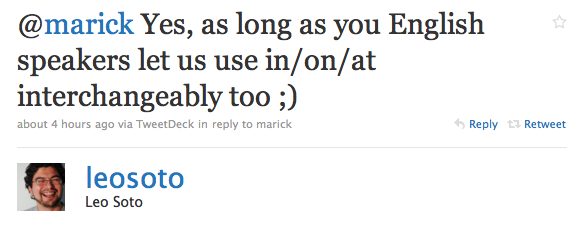
Students of both Spanish and English will be grateful to Leonardo Soto Muñoz (of Lima, Peru) and me. I wrote:

Me

Leo replied:

Him

As of this day, domingo 23 de mayo del 2010, we’ve agreed on these terms.

Old programmers

A correspondent writes:

How does one continue to build a career in software development, when there are younger, hungrier people (i.e.people who can, and will work 16-hour days and can learn things at a ridiculous pace) joining the field?

I’m at the ripe, old age of 33 and am already feeling like it’s a challenge to keep up with the 23-, 24-, 25-year-olds. :/

Also — and I know this is partly a function of the field’s explosive growth over the years — but I just don’t see that many software devs in their 40’s and up, so I don’t have much in the way of precedent to observe, in terms of a career path, other than going into management

Since I’ve pretty much decided to devote this next decade to programming, part of it for hire, this is an important topic to me. (I’m 50.) I don’t know that I have much useful to say, though. Nevertheless…

  • In a team, some people serve as catalysts for other people’s abilities. For example, ever since my 20’s, I’ve been hung up on friction-free work. So I was more likely than other people to make the build work better, write and share emacs functions to automate semi-frequent tasks, or to work on testing. Those are not glory tasks—”I’m a rock star build-fixer!”—but they help the team. As the team’s codger, I might emphasize that bent even more, freeing the team’s whippersnappers to concentrate on the most prodigious feats of coding.

    A typical way in which an older programmer can catalyze is by paying attention to human relationships. If you can avoid the damnable tendency old people have to pontificate at people or tell only marginally relevant stories about how they did it 20 years ago, you can be a person who “jiggles” teams into a better configuration. (Term is due to Weinberg’s Secrets of Consulting, I think.) The ideal role is that of player coach (but one gradually recognized by the team, rather than appointed for it.)

  • Another reason for the patriarch to work in a tight-knit team is that a young programmer’s advantages are not uniform. For example, what makes me feel most like a doddering oldster is the sheer amount of stuff kids these days know about: tool upon tool upon tool, gem upon gem upon gem, the 83 new things in the newest point release of Rails, etc. But if you have one of those people on the team, the advantage accrues to everyone, and the centenarian’s loss of a pack-rat mind is not such a disadvantage.

    When what matters is the team’s capability, balance is more important than each individual’s uniform excellence. So when fogy-dom looms, focus on being complementary rather than unique.

  • A traditional way for the older programmer to cope is by being one of the dwindling number of experts in a has-been technology (Cobol being an example, Smalltalk being another). That technology doesn’t necessarily have to be boring. Sometimes, as has sort of happened with Smalltalk, Lisp, and maybe the purer functional languages, the has-been becomes hot again.

    A perhaps-related route is to become an expert in a very specialized and difficult technology like, say, virtual machines or security–something that’s difficult to pick up quickly and requires continuous learning.

  • Now that we’ve learned that legacy code doesn’t have to suck, perhaps the graybeard should angle to attach himself to a particular large and long-lived code base. There could be a lot of pleasure in watching your well-tended garden improve year after year.

  • It’s also useful not to act old. For example, I have to fight the urge to be sort of smug about not knowing CSS. In my case, of course, I don’t because, well,… CSS. But it’s easily interpreted as my saying “Oh, another passing fad, *Yawn*, give me RPG any day”. Similarly, I should be careful of saying things to Clojure programmers like, “Well the way we did that in my Lisp days was…” As a final example: this website looks like I’ve learned nothing about web technologies since 1994.

    People are sensitive to old people acting old. The flip side is that it’s easy to subvert expectations. I think it’s a good strategy to be able to talk in modest depth about two or three technologies that are sort of new or even faddish. So, for example, I’m pleased that I can talk about Clojure, Cappuccino, and, oh, Sinatra. You want to both present the appearance of being able to–and actually be able to–synthesize the past and the present.

  • Finally: if programming is indeed one of those fields where you do your best work young, older people should be paid less. Older programmers can compete by somehow (credibly) asking for less money.

    That “credibly” is an issue though, since programming is something of a macho, boastful field. In such, a declining salary is easily taken as a big red flag rather than a realistic acknowledgement that–say–short-term memory and concentration are important to programming and both get worse with age.

Other thoughts that might be of help to my fellow coffin-dodgers?

informed-citizens.org

As part of my ongoing (since age 28) midlife crisis, I’ve been casting around for an ambitious product to build. I have an idea. I describe my personal motivation for it, then sketch what “it” is, on a separate blog. I encourage you to try to talk me out of it.

Up in the Air

I saw “Up in the Air” last night. While it’s a well-done movie, albeit entirely predictable, the world it portrays is a lot more disturbing than it seems at first. To explain, I recommend John Holbo’s close reading of David Frum’s Dead Right. Here’s the most relevant part:

[Frum writes] “The great, overwhelming fact of a capitalist economy is risk. Everyone is at constant risk of the loss of his job, or of the destruction of his business by a competitor, or of the crash of his investment portfolio. Risk makes people circumspect. It disciplines them and teaches them self-control. Without a safety net, people won’t try to vault across the big top. Social security, student loans, and other government programs make it far less catastrophic than it used to be for middle-class people to dissolve their families. Without welfare and food stamps, poor people would cling harder to working-class respectability than they do now.”

[Now Holbo] The thing that makes capitalism good, apparently, is not that it generates wealth more efficiently than other known economic engines. No, the thing that makes capitalism good is that, by forcing people to live precarious lives, it causes them to live in fear of losing everything and therefore to adopt – as fearful people will – a cowed and subservient posture: in a word, they behave ‘conservatively’. Of course, crouching to protect themselves and their loved ones from the eternal lash of risk precisely won’t preserve these workers from risk. But the point isn’t to induce a society-wide conformist crouch by way of making the workers safe and happy. The point is to induce a society-wide conformist crouch. Period. A solid foundation is hereby laid for a desirable social order.

*Some Spoilers*

“Up in the Air” is almost unrelentingly conservative in that it simply assumes that the world of work today is the one Frum [seems to] desire. In the movie, Fate–impersonal forces of industry that are faceless until they hire George Clooney–strikes people unexpectedly, and the only solace or support they can have is their family. They get no help from the Agile Alliance, ACM, IEEE, craftsman guilds, AFSCME, AFL-CIO, their community, or the keen-eyed watchdogs of the press whipping up public opinion. There’s some help from the company–of what quality we don’t know–and the government offers only unemployment benefits that are explicitly called out as derisory. There’s some talk of protecting the firing process from lawsuits [government intervention in the process], but in the one case where a lawsuit is credibly threatened, a simple lie by Clooney makes it go away.

In the movie, the people below the airplanes have no option but a socially desirable [to some] defensive crouch. To the extent that movies capture the zeitgeist, that’s pretty disturbing. The movie comes out against atomization–being alone is Clooney’s unhappy fate–but the atoms can’t form molecules bigger than a family. There are no other bonds. OK: there’s Clooney’s last, human gesture to Natalie, but that’s something delivered in extremis, not a way of life. The character of Alex is more representative of the movie’s view of the world: outside the family, there are no norms and no obligations.

The movie shows a world in which Phil Gramm, one of the architects of our current troubles, is on point when he talked about the US as “a nation of whiners“. One strong element of conservatism is the preservation of hierarchy. To Gramm–who need never fear unemployment–I suspect that we-the-people are not particularly relevant. How annoying it must be when we complain! We should shut up, take our lumps, scrape through, and–as in the movie’s closing narrative–watch the planes containing our fate fly far overhead.

Education

When I was in Middle School (~12 years old, around 1971), we did a murder mystery exercise in class. The teacher passed out slips of papers with clues and then shut up. The children milled around aimlessly for a while, comparing slips. Finally, I got fed up, got everyone’s attention, and said, “OK. Everyone with clues about the murder weapon, go over there. Everyone with clues about the victim, over there.” Then I went from group to group, and we quickly solved the mystery.

I learned three things that day.

  1. Sometimes people need external organization to get things done.

  2. I can do that organizing.

  3. People will get mad at me when I do.

The lesson has affected my consulting. I suspect that my daughter’s homework today—identifying the parts of a knight’s armor—will not affect her future in the slightest way. Social studies no longer appears to involve the study of society. Not surprising, I suppose: too much risk of children drawing conclusions that will get their parents mad at the school, and who needs the hassle?

And the New Math rocked, by the way. It was good that I learned simple set theory so young, and the idea that there could be number bases other than ten was a good lesson in questioning the verities.

Bellygraph take 2

I am disgustingly overweight. I would so kick me out of bed for eating a cracker. Hence the return of graphing my weight, as you see above. The embarrassment of displaying my lack of discipline to intellects vast and cool and unsympathetic is apparently what motivates me best.

I’m too embarrassed to show the starting weight.

Facebook and decentralized identifiers

An interesting commentary on the problem of global identifiers, via Michael Tsai. In a nutshell, global identifiers are for the benefit of the implementer, not the user. For many practical purposes, users care about many fewer people than implementers do, and they’re happy to identify those people idiosyncratically.

[…] this approach uses the social network to manage identity, by reducing the size of the problem space by about seven orders of magnitude. It’s perfectly feasible to keep track of the identity of a few hundred people using familiar attributes like names, faces and personal relationships: humans have been doing it for literally hundreds of thousands of years.

I myself am lukewarm on Facebook, but I’m finding Twitter oddly appealing for one of my jobs, keeping track of what interesting communities exist and where they’re going next. More on that later. (My twitter account.)

Numerology

The cost of the Iraq post-war is roughly USD2,000,000,000 per week (EUR 1,442,760,000 today). The population of the US is roughly 300,000,000. That means each person’s share of the Iraq post-war is about… $6.66, or one centiBeast. I would have expected the world to end a couple of years ago, when we reached a full Beast, but this numerology stuff never does seem to work out.

Seven bucks a week isn’t that much, and think of all we get for it:


Switching gears, there are around 27.5 million people in Iraq (July 2007 estimate). So the war costs around USD73.0 per Iraqi per week. Could we just pay them to do whatever it is that they’re supposed to do for the post-war to be considered successful? Well, Sarbast Mohammed works seven days a week at two jobs and brings in around USD120.0 per week. He might appreciate the little top-up to his income. Might win his heart and mind.

Of course, we’d have to get it to him, and we and the Iraqi leadership haven’t done so well at handling reconstruction money in the past. I know the man for the job, though: Karl Rove. He was in charge of the post-Katrina New Orleans reconstruction effort, and we all know how well that went. Since he resigned his job at the White House, he’ll have even more time to do an even better job in Iraq.


Sorry, I’m feeling bitter. I’ve sat in on enough product design discussions to know that it’s easy for the external world to disappear. In many companies, each person’s career depends much more on how she positions herself in relation to her management peers than on how the product is positioned in the marketplace. That’s how silly product decisions happen. The more captive the customer base, the easier it is for primate status games to take over.

Well, I’m a captive customer, observing from the outside, and it seems by far most likely that this post-war will go on until someone figures out how to end it without much risk of taking the blame. The media/government network is too inward-looking to break out of the dollar auction, especially since they can personally lose only status, not blood or money.

On the other hand, 33% of US citizens still believe Saddam Hussein was personally involved in the September 11th attacks. Sorry, 33%-ers, but that’s… not sensible. I could grant you “unsure”, like 9% of your peers—more people should answer polls that way. But “yes” seems so beyond the published evidence that I’m flummoxed: either you or I are not paying anywhere near enough attention to have an opinion.

Yet people do, based (as far as I can tell) solely on artful juxtapositions of “9/11″ and “Saddam Hussein” in speeches. A whole lot of people make bad judgments about political matters based on what really amounts to habit and confirmation bias.

We can’t look at that poll result and ask the Democrats to risk doing anything about Iraq. The populace is not sensible. Yeah, so 64% of people say today that they want withdrawal within the next year. But half of them will be convinced in 2012 that Iraq was just turning the corner in 2008, that they knew that at the time, and that the Democrats went and turned victory into defeat.

We are so screwed.

In such a mood, I find configuring a version control / deployment environment (with Twitter and Jabber notifications from subversion!) strangely comforting: there’s an unending stream of glitches, each of which can be solved.

P.S. Because the above seems too self-righteous, I’m compelled to admit that I’ve had some pretty stupid opinions, both geostrategic and otherwise. For example, my opinions about exercising with ankle pain turn out to have been really, really stupid. I don’t mind that, since one of my goals is: