InfoQ interview up
There’s an interview with me at InfoQ. It covers micro-scale retro-futurist anarcho-syndicalism and my hypothesis that we could chisel value away from automating business-facing examples and add it to cheaper activities.
Someone asked me for advice on how to get invited to speak at conferences. Key advice:
I’ll cover the first two in this note. The details are somewhat particular to my personality and the lucky breaks that came my way. But some of them would work for other people.
(more…)
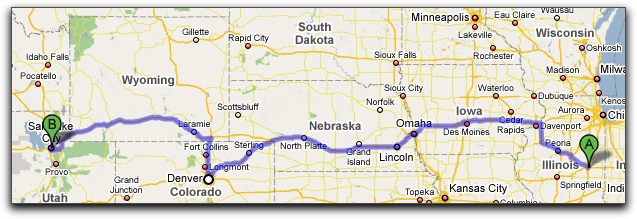
I will be driving this route sometime in late February to early March:

I have to be in Salt Lake City for MountainWest RubyConf on March 13-14. I have no fixed departure date. That’s because I want to do some visiting along the way. I may also do some visiting on the way back.
I have a half-formed plan to use such trips to do research for a book, tentatively titled Travels in Software: What the Great Teams Know. I want to find teams that are special in some way that other teams ought to learn from. It could be that they are particularly good at some specific technique, or that they have a general style that deserves emulation, or that they’re notably long-lived. (I mention the latter because I’ve gotten interested in the idea of “resilient teams”: ones that don’t dissolve because people get bored with what they’re doing, have survived big changes in their corporate environment, etc.)
If you are such a team, let me know.
My idea for a visit would be to “embed” myself in a team for up to a week. I would work with people on the team, pitching in on whatever they’d be doing were I not there. I’d also consume some time interviewing people.
Someone with authority would have to sign a Disclosure Agreement beforehand. Roughly, you’ll have to agree that you have no control over what I write about how you do things, but you can have reasonable control over descriptions of what you’re doing those things to. If you don’t want me to describe the product or your super-duper, soon-to-be-patented algorithms, that’s fine.
UPDATE: Turns out that what I want to do, modeled after something used for RubyConf, can’t be done in stock Twitter. Seeing if I can persuade the Twitter people to work the same magic for me.
Item: Richard P. Gabriel has this habit of making software people write or speak within artificial constraints.
For writers’ workshops (book-length PDF), he’s made reviewers write a summary exactly 29 words long.
In last OOPSLA’s “50 in 50” keynote, he and Guy Steele, Jr., covered the last five decades of programming languages in 50 segments, each exactly 50 words long (in a talk lasting, I believe, about 50 minutes).
The point of constraints is that they make you work: you can’t use the words that first come to mind. You have to struggle to say what you want while playing by the rules them—and sometimes that makes you realize you ought to be wanting to say something else. Constraints are a tool to make you think new thoughts.
Item: I’ve become strangely fond of Twitter. It’s a service that lets you send short (140 character) “tweets” out into the ether. Other people can subscribe to (”follow”) your tweets. They can see the tweets of everyone they follow by visiting their own twitter web page (here’s mine), subscribing to an RSS feed, or using a twitter-specific app to fetch tweets. (I use Twitterrific.)
That’s form: what about content? As Twitter user shalunov (Stanislav Shalunov) puts it (in a tweet):
Four main ways to tweet: ideas, news, @-chat, phatic coffee. The last is the original, rest invented by users.
Ideas are the tweets I’m most interested in. Slalunov’s is an example of an idea tweet.
News is my second interest. As a geographically isolated person, it’s one way of knowing what interesting people are chattering about.
bilkleb, for example, is fond of linking to both technical topics (“heard Paul Tuckfield talk about scaling YouTube MySQL, “mirror disk drives in hardware, stripe in software.” (http://tinyurl.com/277dvy)”, “watching Matz’s Google Talk: http://tinyurl.com/3bzbuu“) and not-technical ones (“@barbjordan http://kluster.com looks interesting.”)
Twitter’s also a good way for me to learn about new and interesting apps for the Mac.
…and I follow lrz because he’s Apple’s Ruby guy, so what he does will affect my next book.
…and there’s also the quick links to the absurd and humorous that’ve been around since the beginning of the web, like this from andytinkham: “This is just wrong, wrong, wrong (on so many levels): http://tinyurl.com/2zjpz5“ or this from objo: “hilarious http://rubyurl.com/DdyJ (via @timbray)”.
“@-chat” is a sort of person-to-person instant messaging. For example, cypher23 wrote “Stalker is a weird and wonderful film.” I replied: “@cypher23 Harrison’s new _Nova Swing_ is in the sub-sub-genre with Stalker, _Rogue Moon_, and _Roadside Picnic_. Liking it so far.” Anyone following cypher23 would see both his tweet and my reply. Someone following only me would see only my reply (but could click on the hyperlinked cypher23 to see all his recent tweets). Because of the one-sidedness, and because the topics tend to be less interesting than those in the first two categories, I tend not to follow people who have a high proportion of @-chat in their tweets.
“Phatic coffee” is just tweeting what you’re doing now, like avibryant’s recent “obsessively refreshing UPS tracking page for new laptop” Although I’m somewhat of a hermit and not much for social chit-chat, I’m not immune to phaticality. (I find chadfowler’s heavily phatic tweets appealing, oddly puckish, and somehow soothing.) But I likely won’t follow someone who’s predominantly phatic.
Item: While writing a book, I often find myself disinclined to spend spare time writing blog posts. Yet I continue to have ideas. I’m sure lots of other people do too.
Synthesis: I’ve created a fake twitter user named pithysoft. It’s for anyone’s pithy tweets about software development. When I finish this post, I’ll send the first one: “d pithysoft Business-facing tests are like personal ads: No matter how exact your description, the reality always tells you something new.” People following pithysoft will see it. If the pithy claim intrigues them, they can tweet pithysoft with something like “@marick More about tests and personal ads, plz”. That would encourage me to write it up on my blog. When I did that, I could tweet “@pithysoft Expanded on XYX here: XYX”
An experiment. Let’s see how it goes.
Jason Gorman compares Scrum to a virus. He uses the example of a DNA virus that destroys the cells it infects. But it could be an endogenous retrovirus that infects the DNA of germ (reproductive) cells and thereby takes over an entire species. From an interesting New Yorker article:
It takes less than two per cent of our genome to create all the proteins necessary for us to live. Eight per cent, however, is composed of broken and disabled retroviruses, which, millions of years ago, managed to embed themselves in the DNA of our ancestors. They are called endogenous retroviruses, because once they infect the DNA of a species they become part of that species.
There is even some evidence that:
without endogenous retroviruses mammals might never have developed a placenta, which protects the fetus and gives it time to mature. That led to live birth, one of the hallmarks of our evolutionary success over birds, reptiles, and fish. Eggs cannot eliminate waste or draw the maternal nutrients required to develop the large brains that have made mammals so versatile. “These viruses made those changes possible,’’ Heidmann told me. “It is quite possible that, without them, human beings would still be laying eggs.”
So that kind of Scrum-as-a-virus could be a positive and enduring good (though there’s a lot of suffering amongst the “early adopters”).
I had a thought at the Simple Design and Test conference.
“Simple” is an adjective, but there are different kinds of adjectives. For example, one might point at a can and say that the adjective “blue” applies to it. That use of the adjective is objectively true, at least in Richard Rorty’s sense: we use the adjective “objective” to describe those statements it’s pretty easy to get people to agree about. The harder it is to get people to agree, the more subjective the statement.
However, suppose the can contains iced coffee. I claim that the adjective “tasty” does not apply, but other people would disagree. Here’s an adjective that quite clearly depends not just on the object it labels but also on the person doing the labeling.
Finally, consider a bed labeled “comfortable”. To be more specific, suppose it’s a waterbed. A waterbed might be extremely comfortable for sleeping, but someone I trust tells me it wouldn’t be comfortable when making love, and I’m quite sure that no waterbed would be a comfortable platform for doing deadlifts. Here we have a case where the suitability of the adjective is bound up with both the person applying it and the activity they’re thinking about.
I claim that “simple”, when it comes to “design and test”, is most like the third category. In a way, when we say “that’s a simple design”, what we should be saying is “that design lets me do actions X, Y, and Z without friction and with ease.”
So: when we talk about what properties make, say, a design “simple,” we’re using shorthand: “I’ve noticed that property X is usually associated with designs that make activities A, B, and C easy.” The fact that we have a hard time getting people to recognize or desire simple designs suggests that we maybe ought to focus on understanding and explaining the activities over capturing the properties.
A transcript of an OOPSLA talk: Table of contents
Update 1, update 2, update 3: Added links to some useful reviews.
A transcript of an OOPSLA talk: Table of contents
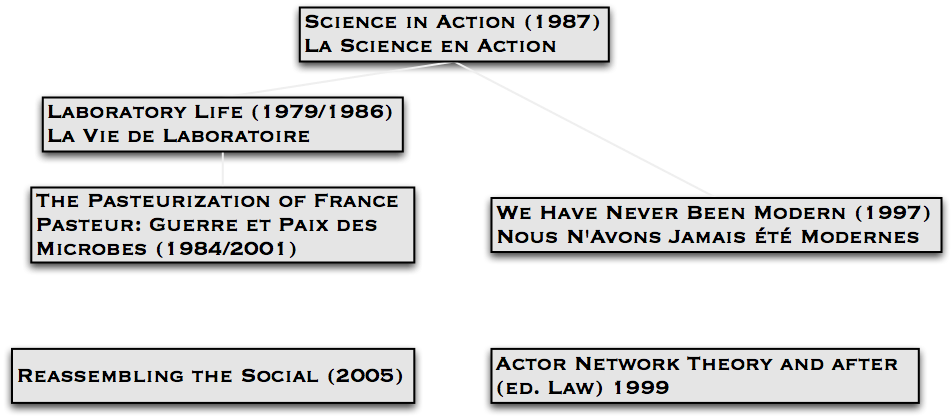
Here is the table of contents for a set of postings that, together, are a transcript of an OOPSLA talk on Bruno Latour and Actor-Network Theory (ANT). I will add links as I post new entries.
Testing as an example: I use Actor-Network theory as a way to get ideas while consulting. Here’s one example.
ANT and the building of the social: ANT is about tracing how “actors” (people and things) in a story push on each other. Stable patterns of interaction produce social objects like neighborhoods.
Anthrax and standups: ANT analyses often give uncommon weight to inanimate objects. How that gave me an idea to make standups less dull.
The divide: Early Agile, especially XP, had an ANTian delight in the interplay between the social and tools. That’s being lost. Someone should do something about it.
A transcript of an OOPSLA talk: Table of contents
Shift gears now to the daily standup. There’s a ritual: someone says what she did yesterday, what she plans to do today, and what impediments she sees in the team’s path. Good standups are crisp and motivating. A lot of standups are bad. They have the enervating effect of an hour-plus weekly status meeting, only spread out over a week.
Why is this? And what can be done about it?
To answer, I’ll start with the story of the anthrax bacillus from Latour’s The Pasteurization of France. At one point, there was a disease called “anthrax.” People understood the properties of this disease: they knew what symptoms it had, they knew that people could contract the disease from warm corpses but not from cold or rotten ones, and they knew that some “accursed” fields gave anthrax to any animal that grazed there.
Pasteur wanted to replace anthrax-the-disease with anthrax-a-bacillus. He undertook a fairly systematic programme:
Early on, he could induce the symptoms of anthrax by extracting icky stuff from a sick animal, diluting it fantastically, and then injecting a tiny bit of the dilute solution into a new animal. However: so? No one sneaks around at night injecting cows in fields.
So the next step is to induce anthrax by a more natural means. They tried feeding the animals hay laced with anthrax, but that didn’t give them the disease. However, a feed more representative of real life—feed containing prickly nettles—did. So there’s a realistic way animals can get the disease that’s directly traceable to the idea of injection.
What about the slaughterhouse workers and the safe corpses? Well, it turns out that anthrax forms spores to ride out harsh environments: like the cold, nasty environment of a dead animal. That’s a plausible explanation for what renderers know. One more bit of anthrax-the-disease can be explained in terms of anthrax-the-bacillus.
There’s even a reason for accursed fields. Suppose someone buries an animal dead of anthrax. You’ve basically buried a whole pile of spores. In dirt. That contains earthworms. One of the things that earthworms do is turn dirt over, moving dirt from down below to the surface. As a side-effect, they steadily replenish the surface with spores. Result: an accursed field, perhaps accursed well after the last person’s forgotten anything was buried there.
And, finally, you can do more with the bacillus than you can with the disease. In particular, you can make a vaccine.
At some point, anthrax-the-disease can be understood in terms of anthrax-the-bacillus. Roles switch: now if you want to say something about the disease, you have to be prepared to trace that statement back to the bacillus.
In the jargon, the bacillus has become an obligatory point of passage.
One of the things we’ve done in Agile is to make the frequent creation of running, tested, potentially shippable software into an obligatory point of passage. Teams that don’t produce potentially shippable software at the end of each iteration are likely in trouble. Moreover, team members ought to be able to trace what they’re doing to the goals of the release; if not, they ought to be prepared to question what they’re doing.
In order to understand and pace the work of the release, it’s convenient to break it down into smaller pieces, individual stories. The stories are also individual points of passage, just littler ones.
Dull standups often make no reference to visible stories. Either people don’t have a wall with stories on it, they don’t do the standup in front of that wall, or they don’t gesture at the wall while speaking. In ANTian terms, they’re demonstrating that the stories aren’t really obligatory points of passage. What to do about that?
Another trick of ANT’s is not to bother making a distinction between humans and other kinds of actors. So, when Kent Beck writes, in the introduction to Smalltalk Best-Practice Patterns, “If you’re programming along, and all of a sudden your program gets balky, makes things hard for you, it’s talking,” an ANT analysis wouldn’t report that with a side-comment like “Of course, programs don’t really get balky.” Lots of programmers talk as if code can push back, so why not take them at their word and see what comes of that?
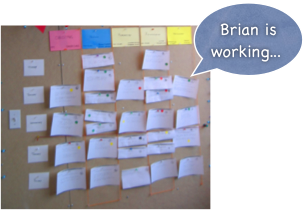
A while back, I was thinking along these lines when I realized that if the stories are so important to the project, they ought to be the ones speaking in the standup. I imagined a story card saying, “Brian’s going to keep working on me today, but he’s having trouble. He could use the help of someone who knows Hibernate.”

Now, I never had the nerve to actually suggest that team members ought to hold the story cards like little mouths, open and close them, and pretend it was the stories talking, but while I was preparing for this talk, I had another thought. Yes, the stories can’t talk, but there’s no reason not to structure the standup around them. Instead of going around the people, you can step through all the stories in play. For each, someone can say what happened to that story yesterday, what’s to be done on it today, and whether there are any risks to its completion.
I plan to recommend that clients give this a try. At least, it will cut out conversational deadeners like “I paired with Dawn and Karl, so I did the same thing they did” and “I can’t remember what I did.” [I’m also pleased that two people said they’d try it on their teams when they got home.]
So, there: another example of using a weirdo theory from sociologist to give myself ideas.
Story board from arbdesign.dk, woman with fish from Willem Velthoven.

A transcript of an OOPSLA talk: Table of contents
Why does Actor-Network Theory (ANT) care so much about things? Latour explains in terms of baboons. Baboons usually have a pretty good life. They don’t have to spend a whole lot of time looking for food, but they do need protection from predators. That means they need to live in packs to survive. How do they keep the packs functioning well? In the words of the Agile Manifesto, they spend a lot of time attending to individuals and interactions. In fact, they spend all their free time attending to individuals and interactions. As a result, they have no time to write software.
We humans have a trick: we substitute things for social forces. Latour uses the example of policemen. Let’s say that society has decided that people should drive slowly down a particular stretch of road. People being what they are, sometimes some of them will want to drive fast instead. One way to prevent that is to station a policeman by the side of the road. That person exerts a social force that will cause people to slow down.
But then we’d be like the baboon: devoting a lot of time to maintaining group norms. Unlike the baboons, though, we have an alternative:

In the US, we call these “speed bumps.” In other parts of the world, they’re called “sleeping policemen.” (The model pictured is a Rediweld Sitecop sleeping policeman.)
Through a different mechanism, the sleeping policeman has the same social effect as a human policeman: slower cars and an environment matching collective preferences.
We can take this a step further. Consider neighborhoods. Many sociologists might explain the existence of neighborhoods by appealing to powerful abstract forces like power, class, or racism. An ANT explanation, by contrast, might start with speed bumps.
Consider a car as an “actor” that can affect—push on, act as a force upon—other actors, specifically children. Speeding cars are a danger to children, and they affect their behavior. Children aren’t allowed to play near streets where cars travel fast.
Now suppose speed bumps are put up across those streets. The speed bumps mediate or “translate” the effect of cars on children. The cars become less dangerous. Parents (another set of actors) are more likely to allow children to play outside. As many parents know, children who are playing together outside soon invade houses in packs. Parents come to know the nearby children. And, inevitably, they come to know those childrens’ parents. They begin trading favors like driving children around. They become neighborly.
Now, speed bumps by themselves don’t create a neighborhood, but there are lots of other physical objects that have similar effects, and they keep having these effects, day in and day out. The continual recurrence (”circulation”) of all these forces, all these actors affecting other actors, is (according to ANT) a sufficient explanation for the “assembly” of a neighborhood. We don’t need to bring abstractions like power into the equation.
Does that make neighborhoods somehow less real than cars? (Is ANT purely materialist?) To Latour, neighborhoods are as real as cars if the people in the story talk about them that way. For example, the city council in my town would, if you asked them, say my neighborhood is real. Some time ago, the city wanted to replace our antique street lamps with ugly modern street lamps. The neighborhood pushed back and got more expensive street lamps that fit better with our lovely old brick streets and old trees. To the city council and the people reading about the brouhaha in the newspaper, the neighborhood was an actor that changed things. To Latour, it would be arrogant for an analyst on the outside to tell us that our neighborhood isn’t really real. ANT comes with a respect for the ontology of the people doing the work; that is, it assumes they’re pretty savvy about what things exist in their world.